
Service Areas
Commercial Roofing Contractors Downtown Midland, TX
Commercial Roofers in Downtown Midland, TX
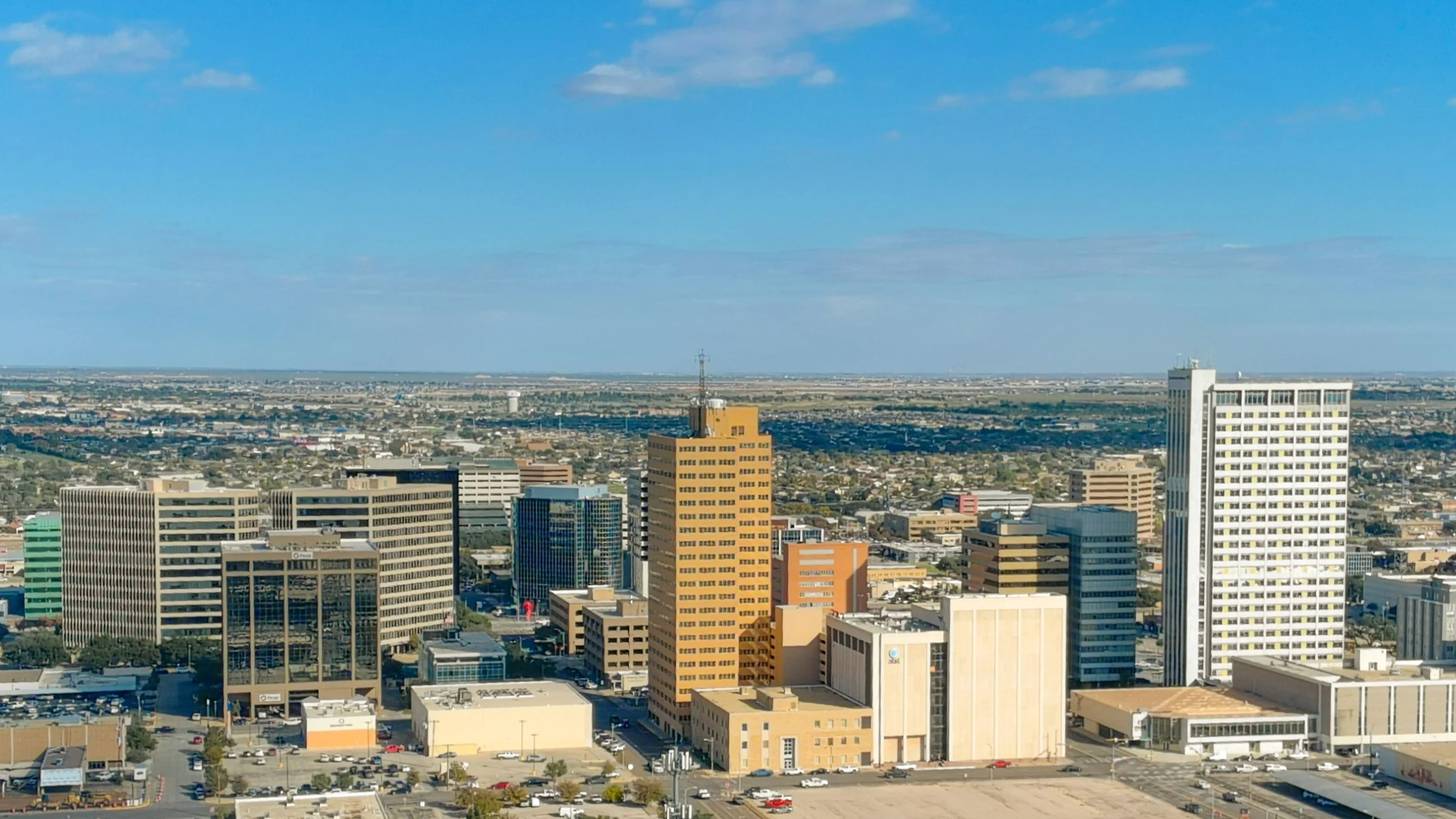
Commercial roofers serving Downtown Midland, TX should document leak sources, wet insulation, drainage, edge details, penetrations, and repair history before recommending a scope. Midland has been called the Tall City since the 1930s, and downtown still earns the name: a cluster of energy company office towers, hotels, and civic buildings rising well above the single-story service yards that dominate the rest of town. A roof six or ten stories up answers to different wind physics than a warehouse three miles out on the loop, and it usually has tenants below it who notice a leak within the hour.
Wind Uplift Changes With Height as Much as With Wind Speed
The velocity pressure a roof deck actually experiences scales with height above grade, so the same regional wind speed produces a larger uplift load on a ten-story roof than it does at grade. That's before accounting for the turbulence downtown towers create for each other, funneling gusts between buildings in ways a standalone structure never sees.
Corner and perimeter zone widths also scale with the smaller of building height or plan dimension, which means a tall downtown footprint carries a wider high-suction corner zone than a low, sprawling building of the same square footage. In practice that calls for tighter fastener spacing at the corners and perimeter, or a fully adhered membrane in those zones, even when the field of the roof is mechanically attached at a standard pattern.
What's Actually Up There: Built-Up and Modified Bitumen From Past Boom Cycles
Several downtown towers and hotels went up, or were re-skinned, during earlier oil booms, and a fair number still carry gravel-surfaced built-up roofing or a granulated modified bitumen cap sheet from that era. Decades of UV and thermal cycling embrittle the asphalt in those systems, and granule loss exposes bare asphalt to accelerated aging exactly where the roof needs its surfacing most.
Base flashing at parapet-to-deck transitions is usually the first thing to crack on a roof this age, well before the field membrane fails outright. Owners are generally choosing between a mod-bit recover with new cap sheet and reinforced base flashing, or a full conversion to an adhered TPO system with tapered insulation added to correct decades of accumulated ponding at the low points.
Hotels, RTU Density, and Reroofing Above Occupied Floors
Downtown hotel roofs carry a dense field of package rooftop units, kitchen exhaust curbs, and sometimes a small cooling tower, and every one of those penetrations is a flashing detail that has to be re-done correctly rather than patched around on the cheap. More curbs means more opportunities for a rushed crew to leave a weak point, and on a roof this crowded with equipment, the flashing work at the curbs usually takes longer than the field membrane itself.
Reroofing above occupied guest floors means the job runs in phases: each section gets torn off and dried in the same day, materials stage away from active mechanical rooms, and the loudest demolition gets scheduled around the hotel's own operations. West Texas afternoon thunderstorms build fast in the warmer months, so dry-in materials stay pre-staged through every phase in case a cell rolls through before a section is closed up.
Coping, Parapets, and the Edge Detail That Actually Holds
Negative pressure at a parapet coping peaks at exactly the spot field crews are most tempted to rush: the corners. Edge metal tested to ANSI/SPRI ES-1 with a continuous cleat is the difference between coping that survives a wind event and coping that peels back like the lid of a can.
- Ponding at interior drains or scuppers that hasn't cleared within a day or two of rain
- Bald patches where granule surfacing has worn through to bare asphalt
- Lifted or oil-canning coping seams along the parapet cap
- Blistering across the membrane surface
- Staining or streaking on parapet base flashing
- Rust bleed at the corners of older RTU curbs
Many of downtown's parapets are masonry-capped and carry original 1970s or '80s coping stock. That older detail usually needs an engineered transition rather than a field-bent aluminum patch, particularly where the original cleat has already pulled loose once.
Civic Buildings: Same Wind Zone, Different Owner Process
The courthouse, city hall, and other civic buildings downtown sit in the same exposure category and face the same uplift math as the office towers next door, but public ownership changes the process around the work. Procurement timelines run longer, budgets get approved in phases across fiscal years, and every product substitution needs to be documented against the original spec.
We write reroofing specs for civic buildings the same way we'd write one for a private tower, then break the submittal and documentation package out in the format a public buyer actually needs to move it through approval.
What Downtown Building Owners and Managers Ask Us
Does a ten-story building really need a different roof system than a single-story warehouse three miles away?
Yes. The uplift pressure at height and at the corners of a tall footprint is measurably higher than at grade, which changes fastening density, membrane attachment method, and edge-metal requirements even before you consider what's actually on the roof.
Can a hotel be reroofed without shutting down floors?
Generally, yes, by working in phases small enough to tear off and dry in within a single day and scheduling the noisiest work around guest hours.
What's causing the bald spots on our modified bitumen roof?
Granule loss from age, foot traffic, or past hail exposes the asphalt underneath to direct UV, which accelerates embrittlement in that spot faster than the surrounding membrane.
Is a fully adhered membrane worth the extra cost downtown?
At the height and corner conditions common downtown, the added uplift resistance of a fully adhered system is usually worth the premium, particularly at the perimeter and corner zones even if the field uses a mechanically attached layout.
Do civic buildings need different documentation for reroofing?
Yes. Public ownership typically requires a more formal submittal and approval trail than a private building, and we build that into the spec from the start rather than assembling it after the fact.