Commercial Project Types
Self-Storage Facility Roofing in Midland, TX
Long-Run Metal Roofing for Self-Storage Buildings Across the Basin
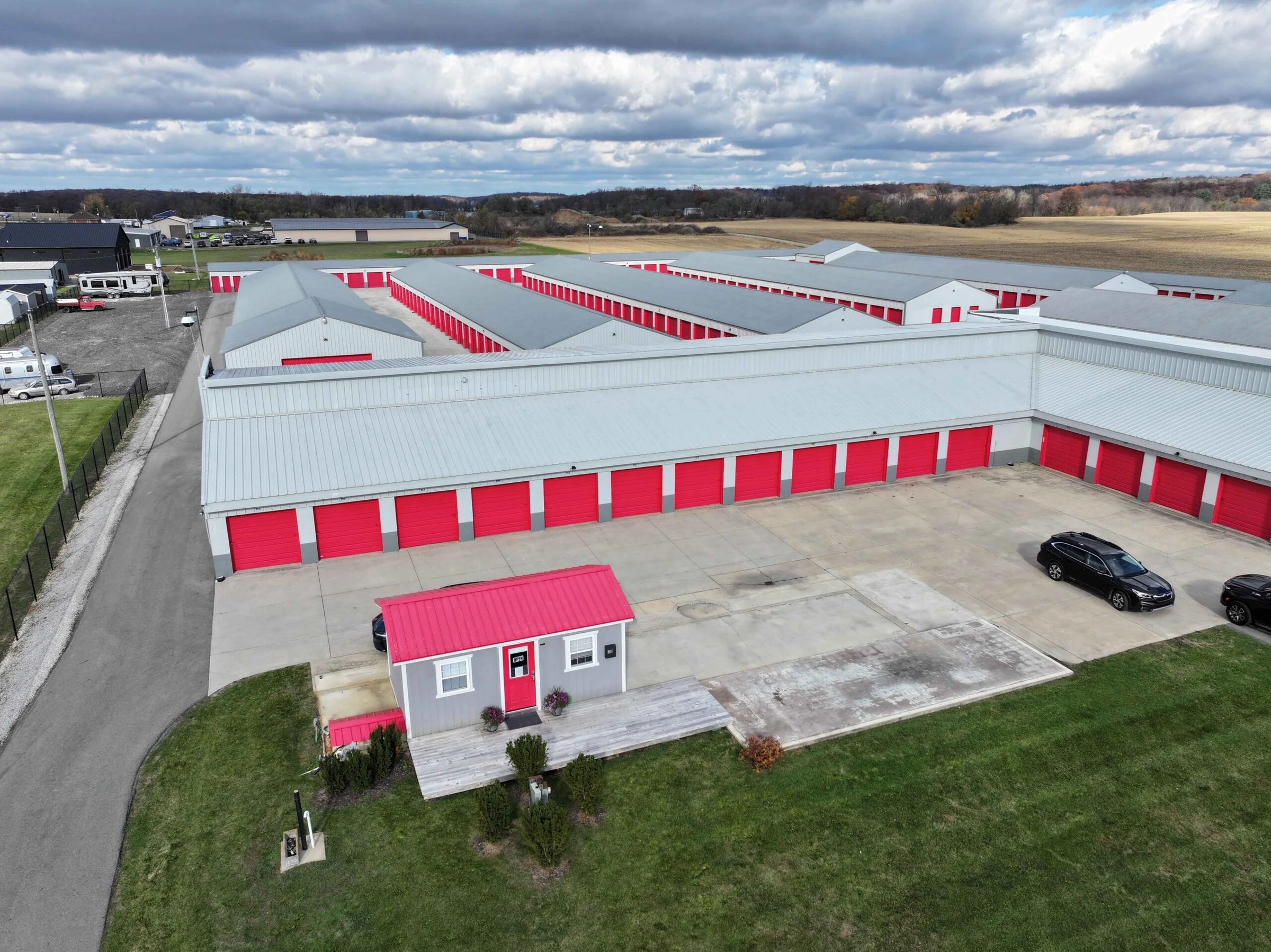
Self-storage facilities in this market range from simple exposed-fastener metal buildings with rows of drive-up units to newer climate-controlled facilities built more like a conditioned warehouse, and the roofing needs for each type diverge sharply even though both are technically metal building roofs.
Long, Narrow Roof Runs Over Drive-Up Unit Rows
The classic self-storage layout, long narrow buildings arranged in parallel rows with drive-up unit doors on both sides, creates roof spans that are long relative to their width, and wind uplift behaves differently on a narrow, elongated roof than on a square or more compact building footprint. Corner and end-of-building wind pressure zones on these narrow structures can be more severe proportionally than on a compact building of the same total square footage, and we calculate fastening patterns for R-panel or standing seam roofing on these buildings with that elongated geometry specifically in mind rather than applying a generic metal building fastening chart.
Panel end laps at the building ends, where wind pressure concentrates most, are also where we see the earliest signs of fastener backout and panel lift on older self-storage buildings in this market. Re-fastening or adding closure strips at these end conditions during a maintenance visit is one of the more cost-effective interventions available on an aging metal storage building roof.
Rust and Corrosion at Aging Panel Laps
Older exposed-fastener metal buildings in this market, some of which have been standing since earlier oil boom construction waves decades back, show rust developing first at panel side laps and around fastener penetrations where the factory coating has worn thin from UV exposure and thermal cycling. We inspect panel laps and fastener condition closely on any older storage building, since a rusted fastener that has lost its washer seal is a leak point even before the surrounding panel shows visible corrosion.
A silicone or acrylic roof coating applied over a sound but aging metal panel roof can extend service life significantly for an owner-operator who wants to avoid a full panel replacement, provided the existing panel substrate is structurally sound and rust has not progressed to the point of perforation. We evaluate panel condition honestly before recommending a coating, since coating over a panel with active perforating rust just delays a more expensive repair rather than solving it.
Insulation Differences Between Standard and Climate-Controlled Storage
Standard drive-up self-storage units are unconditioned space, and the roof over them needs minimal insulation, mainly enough to reduce interior temperature swings and condensation risk rather than to hit an occupied-building R-value target. Climate-controlled storage facilities, a newer product type we are seeing more of in this market as operators compete on amenities, condition the interior space and need an insulation package closer to what a conditioned warehouse requires, along with vapor barrier attention that unconditioned storage buildings do not need at all.
- Fastening pattern calculated for the elongated, narrow geometry typical of storage building rows
- Panel end lap and closure strip condition checked at building ends where wind pressure concentrates
- Rust and fastener corrosion inspection before recommending a coating over full panel replacement
- Insulation package matched to conditioned versus unconditioned storage product type
- Boat, RV, and equipment storage canopy roofs inspected separately from enclosed unit buildings
Boat, RV, and Oilfield Equipment Storage Canopies
A number of self-storage properties in this market include open canopy structures for boat, RV, or oilfield equipment storage alongside the enclosed unit buildings, and these canopy roofs are typically a simpler exposed structural steel frame with a metal panel roof and no walls beneath. Wind uplift on an open canopy behaves differently than on an enclosed building, since wind can act on the underside of the canopy roof as well as the top, and fastening for these structures needs to account for that dual-direction pressure rather than assuming the same fastening logic that applies to an enclosed building roof.
Low-Maintenance Priorities for Owner-Operators
Many self-storage facilities in this market are owned and managed by smaller operators without a dedicated facilities staff, which means the roofing approach needs to prioritize low-maintenance solutions over systems that require frequent specialized upkeep. We favor coating systems and panel repair approaches that an owner-operator can reasonably maintain with periodic inspection rather than assemblies that need specialized servicing the ownership structure is not set up to provide.
Questions From Self-Storage Owners and Operators
Why do storage building roofs fail first at the ends rather than in the middle?
Wind pressure concentrates most heavily at the building ends on long, narrow storage structures, and panel end laps and closure strips there show fastener backout and panel lift earlier than the rest of the roof field.
Can a coating be applied over a metal roof that already shows some rust?
Only if the underlying panel is still structurally sound with no active perforating rust, since coating over a panel that is already perforating just delays a more expensive repair rather than resolving it.
Does a climate-controlled storage building need a different roof than standard drive-up units?
Yes, the insulation package and vapor barrier strategy need to match the conditioned interior space, closer to what a conditioned warehouse needs, rather than the minimal insulation appropriate for unconditioned units.
How is wind uplift different on an open storage canopy versus an enclosed building?
Wind can act on the underside of an open canopy roof as well as the top, so fastening needs to account for pressure from both directions rather than the single-direction uplift calculation used on an enclosed building.
What roofing approach works best for an owner-operator without dedicated facilities staff?
We generally favor coating systems and straightforward panel repair approaches that can be maintained with periodic inspection, rather than assemblies requiring specialized servicing the ownership structure is not equipped to manage.