
Commercial Roofing Services
Storm Damage Roof Repair in Midland, TX
Repair Decisions After Hail and Straight-Line Wind Events
Hail and wind are the two things that put the most commercial roofs in this region into an unplanned repair cycle. They damage a roof differently, and telling them apart on inspection is what actually determines whether a section gets patched or the whole roof needs a closer look.
How Hail Damages a Membrane
Hail impact bruises a membrane rather than always puncturing it outright, and that bruising is not always visible from a quick walk. On modified bitumen, hail strips granules off the cap sheet, exposing the asphalt layer beneath to direct UV, which accelerates aging at that spot even without an immediate leak. On single-ply membranes like TPO and EPDM, hail can create soft, compressed spots that look fine on the surface but have lost some of their impact resistance and thickness at that point.
We check for hail damage systematically across the roof rather than only at the first spot noticed, since hail rarely lands in one place. A hailstorm severe enough to cause visible damage in one area has almost certainly stressed the whole field of the roof to some degree, even where it looks undamaged.
How Wind Damage Shows Up Differently
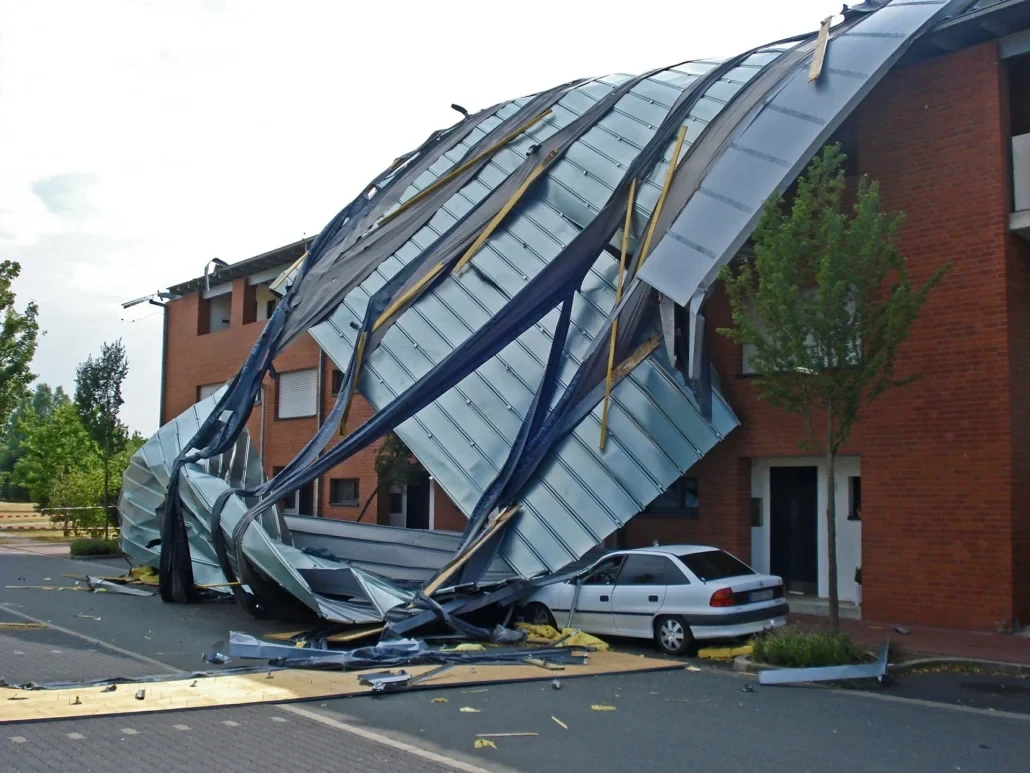
Wind failures concentrate at the edges and corners of a roof rather than across the general field, which is exactly where uplift pressure is highest during a straight-line wind event. We see membrane peeled back at a corner, coping metal blown loose or missing along a parapet edge, and fasteners pulled through at perimeter zones where the original spacing did not hold under load.
Rooftop equipment takes wind damage too. Curb flashing can lift or tear during high wind even if the unit itself stays anchored, and that lifted flashing becomes an active leak point the next time it rains, whether or not the storm that caused it produced any hail at all.
Assessment Methodology
We assess storm damage in a set order: interior check for any active leak or stain first, then a full roof walk checking membrane surface condition, seam integrity, and edge and corner detail, then a check of rooftop equipment curbs and flashing. Photos and measurements get taken at every damage point found, dated to the inspection, which matters for separating storm-caused damage from pre-existing wear.
On a roof with a documented maintenance and inspection history, this assessment moves faster because we have a clear baseline of prior condition to compare against. On a roof with no history, the assessment takes longer since we have to establish what is storm damage versus what was already there.
Repair Versus Replace Decision Framework
Isolated hail bruising or a single corner uplift failure on an otherwise sound, well-maintained roof usually gets a targeted repair: cut out and patch the damaged membrane section, refasten and reseal the affected edge or corner detail. That is the majority of storm calls.
Widespread hail damage across an aging membrane, or wind damage that reveals a fastening pattern that never matched current uplift standards, points toward a larger conversation. In those cases, repeated storm repairs on a roof nearing the end of its service life often cost more over a short window than planning for replacement, and we say so directly rather than running up repair costs on a roof that is not going to hold much longer regardless.
What Gets Documented for the Facility Record
Every storm repair gets tied to a specific storm date, with photos, measurements, and a description of what failed and what was done about it. That record separates storm-related repairs from routine maintenance in the roof's history, which matters for future inspections and for any documentation process the facility manager needs to support internally or with an insurer.
- Interior check for active leaks before the roof walk begins
- Full membrane surface inspection for hail bruising and granule loss
- Edge and corner check for wind-related uplift damage
- Rooftop equipment curb and flashing inspection
- Dated photo and measurement documentation at each damage point
- Repair-versus-replace assessment based on damage extent and roof age
Repairing Around an Occupied Building
Storm repair work happens while the building keeps running in almost every case. We stage repairs to keep active work areas away from tenant or operations traffic, and we prioritize any active leak location first regardless of where it falls in the overall repair sequence.
Storm Damage Repair Questions We Hear Often
Can hail damage a roof without leaving an obvious hole?
Yes. Hail commonly bruises membrane or strips granules without punching through, and that damage is not always visible without a close inspection of the surface.
Why does wind damage concentrate at the edges of the roof?
Wind uplift pressure is highest at corners and perimeters during a storm, which is why fastener spacing tightens in those zones on a properly designed roof and why damage tends to start there first.
How do you tell storm damage apart from ordinary wear?
A documented inspection history helps most. Without one, we assess damage patterns and location against how storm damage typically presents versus gradual wear, and we are direct when the distinction is not clear-cut.
Is it ever better to replace instead of repair after a storm?
Yes, when damage is widespread across an aging membrane or when repeated storm repairs are becoming more frequent on a roof already nearing the end of its service life.
Do you provide documentation we can use for our own records or an adjuster?
Yes. We document damage with dated photos and measurements as a factual record of what was found and what was repaired, without making any representation about how a claim will be handled.