
Commercial Roofing Services
Standing Seam Metal Roofing in Midland, TX
Standing Seam Metal Roofs for Distribution Buildings and Hotel Accents
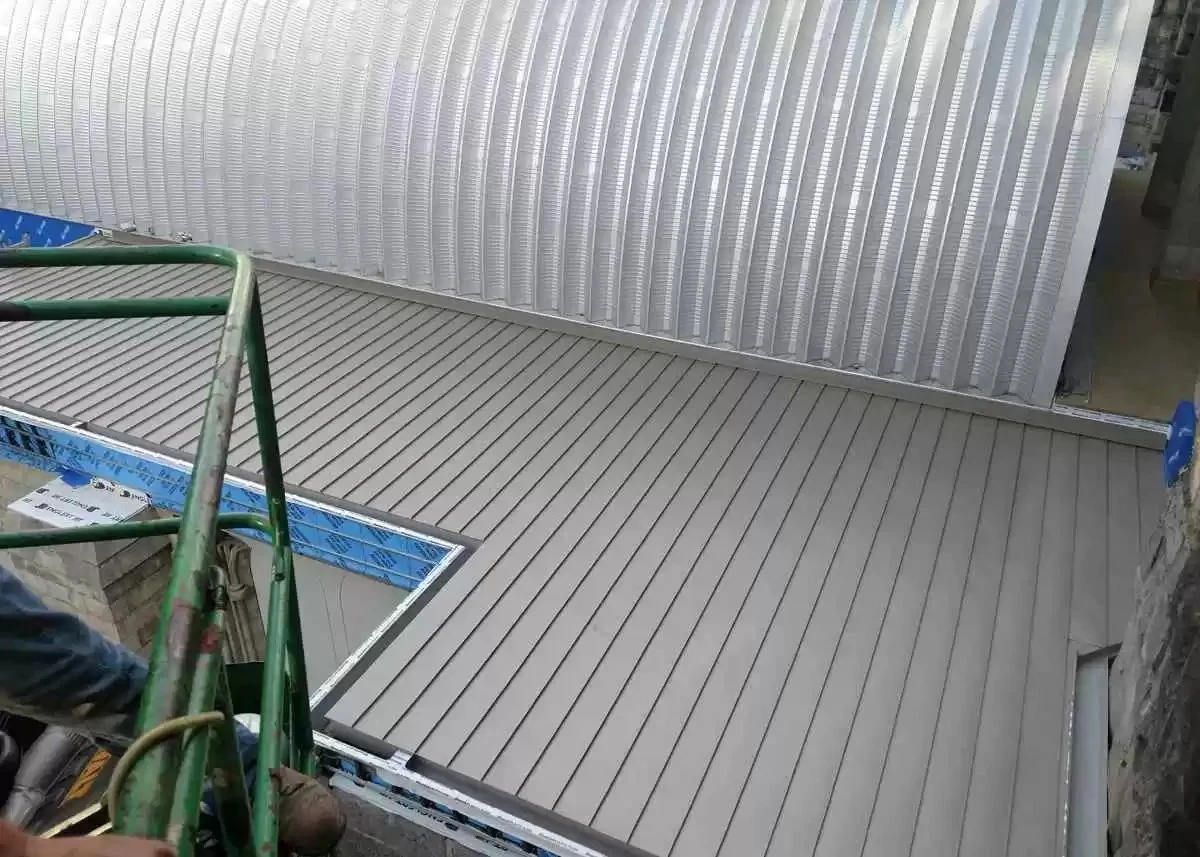
Standing seam metal roofing shows up around Midland on distribution buildings, hotel porte-cocheres and mansard accents, and the occasional office building looking for a sloped roof rather than a low-slope membrane deck. Its concealed-fastener design and interlocking seams handle this region's wind uplift and thermal cycling differently than exposed-fastener panels, and the clip system is where most of the engineering decisions actually live.
Concealed Fasteners and Uplift Resistance
Unlike exposed-fastener R-panel, standing seam panels attach to the deck through concealed clips at the seams rather than screws driven through the panel face. That clip-and-seam system is engineered specifically for uplift resistance, and clip spacing gets tightened at corners, ridges, and eaves — the same higher-pressure zones we account for on every membrane system in this market — to meet the wind uplift ratings the building's exposure category demands.
Because there's no exposed fastener penetrating the panel face, standing seam avoids the fastener back-out and seal failure that plagues exposed-fastener systems after years of thermal cycling. That's a meaningful advantage in a climate where panels see wide daily temperature swings and expand and contract measurably between a summer afternoon and a clear desert night.
Clip design has evolved to allow more thermal movement without transferring stress into the seam itself, and specifying the right clip type for a given panel run length is as much a part of the engineering as the panel profile itself. A fixed clip at one end of a long run paired with sliding clips along the rest of the length lets the panel expand and contract without buckling the seam.
Oil-Canning and Thermal Movement
Oil-canning — the visible waviness that can appear on flat panel pans under thermal stress — is more of a cosmetic issue than a performance failure, but it shows up more readily in this climate's wide temperature swings than in milder regions. Panel gauge, pan width, and striations or embossing patterns all affect how visible oil-canning becomes, and we discuss that tradeoff with clients upfront rather than letting it become a surprise after installation on a building where appearance matters, like a hotel entrance.
Seam design has to accommodate thermal expansion along the panel's length as well. A properly engineered standing seam system allows the panel to move within the clip without transferring stress to the seam itself, which is part of why clip selection — fixed versus sliding — depends on panel run length and anticipated thermal movement, not only aesthetic preference.
Hail Resistance and Gauge Selection
Metal panel gauge and paint system both affect hail performance, and this is a real consideration given the convective storm activity that moves through the Basin in spring and early summer:
- Heavier gauge steel or aluminum resists denting better under hail impact than lighter gauge panels
- Class 4 impact-rated panels, tested per UL 2218, hold up to the largest common hailstone sizes without puncturing
- Paint and coating systems (PVDF versus polyester) affect both fade resistance and how visible hail denting becomes
- Standing seam's raised rib profile can mask minor denting on the pan better than a flat exposed-fastener panel
- Underlayment selection still matters even with hail-rated panels, as a backstop against any panel breach
On a hotel or distribution building where cosmetic appearance matters to ownership, we'll usually recommend the heavier gauge and impact-rated panel option even at a higher upfront cost, since a dented panel field on a customer-facing building is a visible, ongoing problem.
Where Standing Seam Fits Against Low-Slope Alternatives
Standing seam only makes sense where the roof geometry actually has slope to work with — it's not an option for a flat low-slope deck, which is most of what we see on downtown office towers. Distribution buildings with pitched sections, hotel entrance canopies, and accent roofs on office buildings are the typical applications here. For the flat majority of a distribution building's roof area, we're usually still specifying TPO or another single-ply membrane, with standing seam reserved for sloped sections and architectural accents.
Insulation strategy differs from a membrane roof too — standing seam typically uses a thermal spacer block system or above-deck rigid insulation to hit R-value targets while maintaining an air gap that prevents condensation against the panel's underside, which matters given the temperature swings this climate produces.
We also account for how standing seam integrates with adjacent low-slope sections on a mixed-roof building, which is common on distribution buildings with a sloped entry canopy attached to a flat warehouse roof. Flashing that transition correctly matters more than either roof section performing well independently, since that's where most leaks on mixed assemblies actually originate.
Standing Seam Questions We Hear Often
Is standing seam worth the extra cost over R-panel for a service building?
For a strictly utilitarian service yard building, exposed-fastener R-panel is usually the more cost-effective choice. Standing seam earns its premium on buildings where fastener back-out risk, appearance, or a longer expected service life justify it — see our R-panel page for that comparison.
Does standing seam actually perform better in wind than R-panel?
Generally yes, because concealed clips are specifically engineered for uplift resistance and there's no exposed fastener to work loose over time, which is a common failure mode on exposed-fastener panels after years of thermal cycling.
Can standing seam handle Permian Basin hail?
Heavier gauge and Class 4 impact-rated panels hold up well. We spec gauge and rating based on the building's exposure and how much cosmetic denting an owner is willing to tolerate.
What causes oil-canning and can it be prevented?
Thermal stress on flat panel pans causes it, and panel width, gauge, and striated or embossed patterns all reduce its visibility. It's largely cosmetic, but we discuss the tradeoff before installation rather than after.
How long does a standing seam roof last in this climate?
With a quality paint system and properly engineered clip spacing for this wind exposure category, standing seam roofs generally outlast exposed-fastener panel systems, largely because there's no exposed fastener to fail over time.